When the gates were taken out

I was waiting to go home at 8 am,

stepping aimlessly over

the left-over dirt and stones  

in the courtyard that was raised because  

the inner lanes had to be raised because 

the municipal roads had been raised—  

it was the busyness of a city

keeping itself in shape,

leaving me breathless, 

with my eyes to the ground,

until— 

the gates were taken out

to be raised,

opening a tiny window

in which I hesitate 

before stepping out into the lane

like an inmate tasting her first lick

of forgotten freedom, as if  

the gates had kept me locked in

all this while, as if  

I didn’t belong

on the open Earth outside,

any time  I pleased,

for no reason at all but that I was alive 

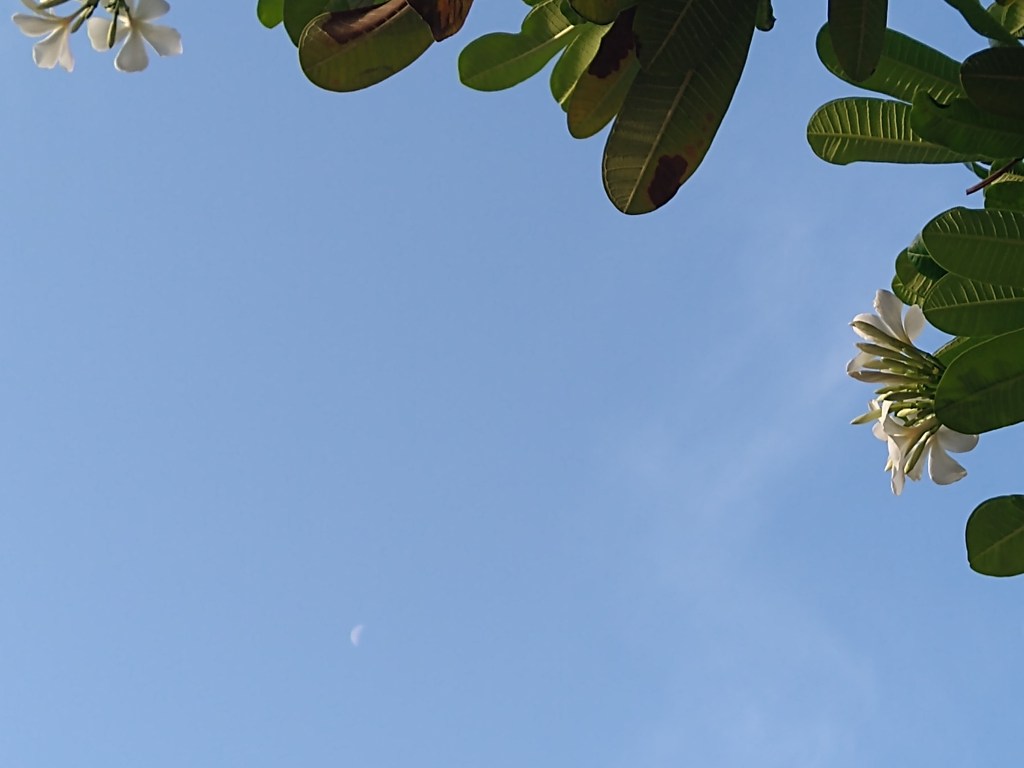
the frangipani flowers lay

thick and white on the ground

with their sunny hearts open, 

I imagine them floating gracefully

off the tree,  which had let them go

under a silent half-moon,  

which lingers even now

above lazy splashes of white,

a brilliant sun shining above us all  

in an endless blue sky,

all of them whispering— 

you are in this soft beauty. 

Our story

The need to tell our story is nearly instinctive. It emerges from our need to be understood, to form psychological communities of our own.

Trouble is, communities form when we tell our story to ready listeners. Communities don’t form when we tell our stories to reluctant listeners.

Both these listeners have already formed their judgements. Your story merely reinforces their judgements of ‘Yes, I’m with you in this’ or ‘No, I’m not with you’.

What you receive after your narration is largely about them, not your narrative. Your narrative is merely the trigger for them to express themselves.

The neatest, least time-wasting, mind space-conserving way is to tell your story only when doing so can bring a real benefit. Not because you merely seek people’s understanding.


What are Rules – My Daughter Asked

In continuation to my previous post..

What are Rules? My daughter asked,

“What about when what we speak can’t hurt someone

because they don’t know?”

I had to think a moment for the answer.

In thought, word or deed, if you do a wrong, you hurt yourself.

Whether people know your thought, word or deed or not is irrelevant.

That you have hurt yourself implies you need to give it up.

So, what is relevant is what you do.

Not whether the world sees it

Or how the world sees it.

Giving up Intelligence

“Submit your intelligence to the Paramatma,” advises an old issue of Rishi Sabha from Sri Sri Publications.


That it is the intelligence that separates your atma from the Paramatma. When you submit, you let go of your ego.


I decided to do that. To me it meant the equivalent of saying, “Dear God, This intelligence is a thing I’ve struggled to believe in most of my life. Strangely, I have also struggled to contain the ego that comes with believing in my intelligence. This intelligence is actually yours. So take it and do what you want with it. When I need it, I will come asking for some – enough to help me by.”


So, when I mentally submitted my intelligence to the Paramatma, or God in my words, it was a letting go – Freedom from a heavy burden, of all my notions of intelligence.


Suddenly, I was free of being intelligent or dumb, creative or straight-jacketed, free of my opinions – which I believed were the truth – and the resultant debates and discussions, some external, others dangerously internal, working in a continuous loop in my own head.


I had a glimpse of what I could be free of – I am this and you are that, there’s a letting go of superiority and inferiority, of being right or wrong, with no need to prove myself to self or any one, to succeed or fail and the freedom not to have an opinion about innumerable things. This leaves me with space to do so much more.


Letting go of this intelligence and all its attachments gives me the freedom to do what comes naturally and that’s the whole point behind being creative. And plenty other things.


All that remains is to choose this freedom. I could so easily continue to refuse it.


School Reunion

There are so many different things I could begin this post with to speak of my school reunion. I was meeting them 25 years later.

I could begin with the fact that we shared our lives, and found that most of us had our usual ups and downs – with just a handful leading those happy lives and a handful leading helpless lives.

Or I could begin at the beginning and speak of how reluctant I was to bring myself to my last reunion.

But they would all be of little interest to you.

So let me begin at the end.

At the End of the Reunion

It took my school reunion for me to learn 3 home truths that bring happiness to my life. I hope they are of some use to you.

  1. To open myself to the world – When I think of the fact that 5 of my school classmates have passed away, or the fact that one of them can no longer see and is worried about his daughter turning blind too – I can’t begin to think how utterly insignificant 80% of the things I’m concerned with in my life are. And I stopped looking inwards to look at what I want; but to look outwards at those around for what they need – and that’s how I view opening myself and letting the world in. It gives me a deep sense of peace if I do it even one bit.
  2. To care for others and see the goodness in them – I met classmates who had kept their lives on hold to take care of their families. Each one without exception wanted to know that each of us was doing well. There was so much care and concern for those that weren’t and they lent a helping hand. And I learnt to have a readiness to listen without judgement and a willingness to help without expectation. It helps me sleep with a smile at the end of the day.
  3. That being happy requires me to just ‘be’ and to do what I love – It doesn’t require me to be at the top of what I do, nor achieve, nor have an audience. I could have walked the 25 years of my life after school with the same confidence that I walked with during school – I used to sing in front of the class (average performance), I acted (less than average), I spoke on stage (good), I studied (good grades), I played (about average).  I was happy just doing. I don’t do them anymore.

And then I was free. Free from the burden of my expectations.