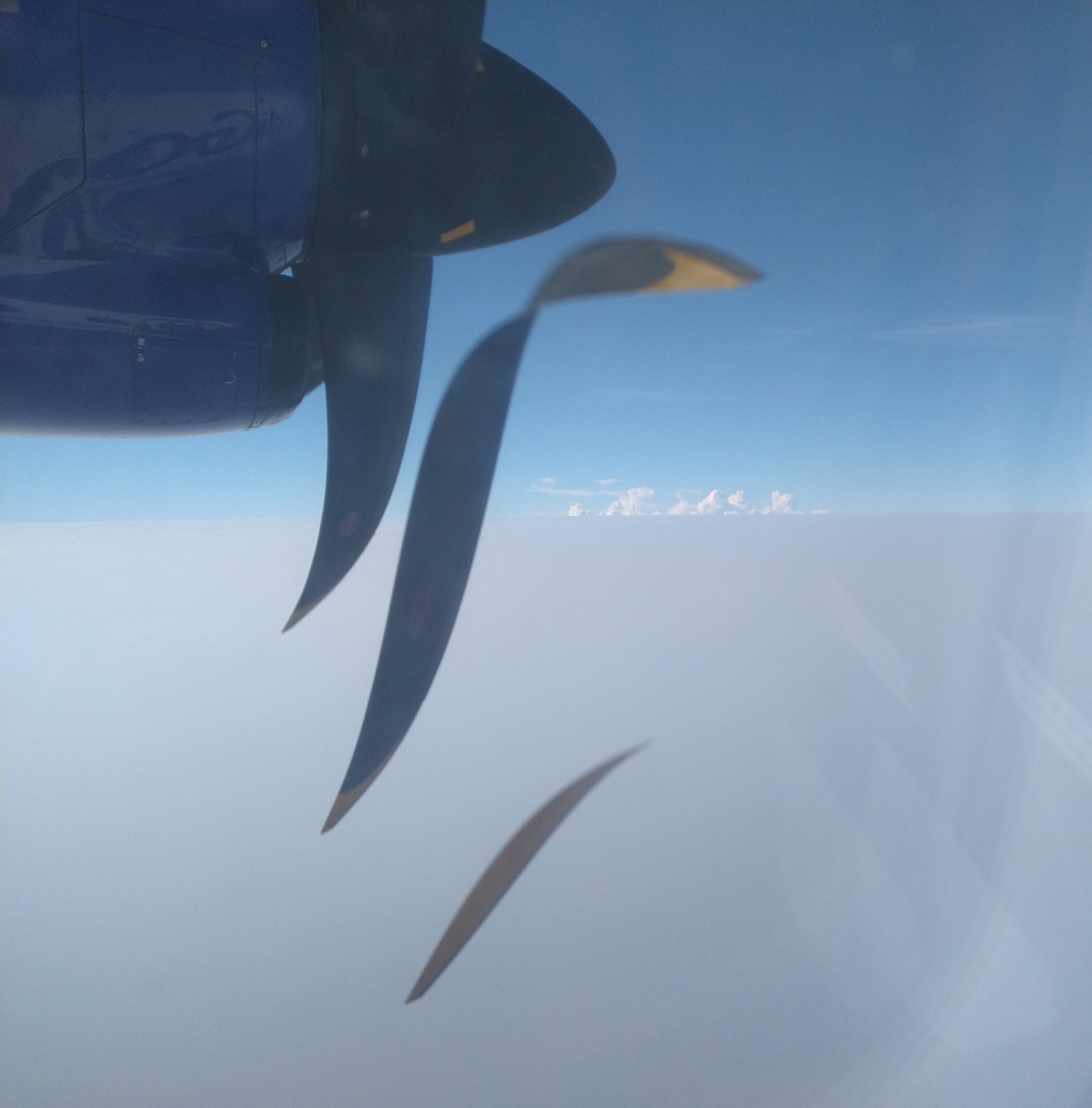
The Illusion of a Snapshot

The grey wall in the photograph interested my fellow passenger and me. I took a few photographs. One photograph gave us another illusion—the blades seemed to be falling off the propeller. 

We were in a familiar and stable circumstance—in an aircraft with pilots at the helm on a sunlit day without turbulence. No impending catastrophe. No turmoil. We could bring curiosity and wonder into play at these unexpected illusions. 

We could see the wall for what it was. A play of light and cloud.  

We could see the blades weren’t falling off. Outside the camera, the propeller whirred.

Life brings us face-to-face with these surprising snapshots—except, these look like reality.  

Fulfilled expectations. Failed expectations. Windfalls. Catastrophes.  

Happy family. Unavailable love. Work pinnacle. Job failure. 

We are so focused on these snapshots that we can’t see the circumstance. We let panic, pain, pride, or entitled pleasure take hold of us. 

To be able to see the circumstance, we must step back from the snapshot. We can then see that when life takes away some stuff, it gives us other stuff—big-time. Vice versa too.
Respecting a Parent’s Space

Two very different ways of dealing with aging parents.

One, keeping them housebound to keep them safe. Another, making the arrangements for them to remain independent and lead the lives they want to lead.  

One, taking the decisions out of their hands. Another, nudging them along to take care of themselves, yet working with their wishes.  

One, harping on the fact that they aren’t doing what they’re told. Another, focusing on doing what you can to take care of the parent.   

The first is about control. The other is about respecting the parent’s space. 

Nuance of Language 

After nearly 30 years, I’m back to speaking my mother tongue daily, and I find that I’m a stranger to the emotional nuance of English. 

Warm words resonate deeper in Telugu. So do the harsh ones. 

When I’m irritated or angry, Telugu words string themselves into harsh frames. I don’t seem to do that in English. I tried translating them into English and found that I was only forming statements without the harshness. Being surrounded by Telugu shows me a layer of anger I wasn’t aware of.

Similarly, the words my extended family uses in addressing me resonate with warmth the way the corresponding English terms (not just translations) don’t.

I believe what we experience in our childhood seeps in so much deeper. To me, Telugu is at once a cradle and a spitfire.

English is a clean slate. It has only surrounded my personal life after I’ve been an adult. I find living in English peaceful.

But Telugu gives me an insight into my childhood influences and the instincts that made me absorb these influences. It peels away the layers and shows me things I had been blind to. 

Across the Chasm 

She returned to the pasture 

carrying the baby  
she had all along. 

Out of the mist,  

a chasm appeared 

a cold wind blew 

a raucous call echoed 

narrow memory lanes kindled.

A darkness settled into her 

waking the baby never quite asleep 

dulling the whisper of her breath 

squalling fury alone in the desert.

A lullaby floated, 

the voice of love  

cloaked in needless words. 

A bridge stretched. 

Across the chasm 

stood a stranger 

with silver hair.

Words spinning themselves 

into cool cotton swaddles 

and warm calloused palms, 

the steadying rhythm 

of hearts beating with hers.

Her life’s longing, 

a warm whisper 

a wispy breath 

at once strange and familiar 

the language of warmth.

She crossed the chasm 

the stranger holding her gaze 

with warm, familiar eyes. 

It was her— 

the baby, she, the silver stranger. 

In trying to get my point across… 

…I’m learning to let go.

Stage one: I wanted people to accept my view. If they didn’t, my ego was hurt. That wasn’t a nice feeling at all.

Stage two: I can’t always get my point across. That used to be terribly frustrating.

Stage three: I needed the person to indicate they’ve heard me. People have their reasons for not always doing that. I think I’ve come some way in recognizing this fact and letting it be.

Stage four: The other person argues back, and the tone sounds like an attack on my viewpoint. The argument is meaningful sometimes, but I still find the tone hard to handle. When I respond to the tone, it leaves a residue.

Stage five: The person goes off on an argumentative tangent. I get carried away by the tone, my voice rises, and I’m responding to the tangent. By now, I want to have the last word as much as the other person wants to. The learning is to remain in the moment. Currently, I’m unable to do that. Typically, it happens with people with whom I have a history of such interactions.

In all these stages, it’s as if the self is already geared to respond in kind. What we call samskaras—psychological imprints. Crossing each stage is about erasing these imprints.

Winding Race

A water drop

came plinking down

to the barren earth.


Finding kin

and joining hands

in prideful glee


With muscle and nerve

from strength of clan—

Foaming and frothing


Pounding rock

Clearing way

Lord of the mountain pass.


Looking down its nose

at a nescient lake

and resting shallows.


Hurtling down

Mighty beast

Thundering bear


Gouging a hole

In the placid lake

that bound and held


till memory’s lost

of foam and roar

and might and rank.


Not glittering drop

but a random speck

on the rolling wheel


A heaving rasp

a winding run,

caught in a race


where there’s none,

deaf to the hum

of the silent core.

Bunny’s Dad

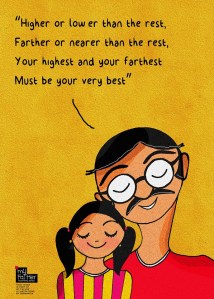
Debasmita’s illsutrated a poem of mine. I was happy to write it – one of the many things I learnt from dad.

ymadhuri blog - debasmita illustration

Bunny rabbit and her dad leapt across the grass

One early morning, and sat in the meadow.


Noses twitching, tubby tails jiggling,

Whiskers whispering in the wind,

Bunny rabbit and her dad,

They sat and watched the sun rise.


“Tell me Bunny,” said dad to Bunny,

“What do you want to be when you grow up?”

“How high do you want to leap?”

“How far do you want to go?”


Bunny sat on her hind legs.

She looked up at her dad and she said,

“Daddy, I want to leap higher than the rest.”

“I want to run farther than the rest.”


“Tell me Bunny,” said dad, his voice grave.

“If your best leap can be higher,

Higher and higher than the others’ leap,

Do you still want to leap just higher than the rest?”


“Oh Bunny,” his eyes softened, “My darling girl,

If your farthest run is farther,

Farther and farther than the rest.

Do you still want to run a wee bit farther than the rest?”


Bunny’s eyes widened. She looked up at the sky.

She looked at the far mountains.

“No daddy,” she said and she smiled.

“I want to be my best, my highest and my farthest.”


Dad licked her head, “Higher or lower than the rest,

Farther or nearer than the rest,

Your highest and your farthest

Must be your very best,” he said.


“And when you do your best each day,

Wake up in the morning to beat your best

Every day, each day, my dear Bunny.

That’s how high you must leap, how far you must run.”

I Am This… I Am That

I am this… I am that

I am techie, I am writer

I am Chowdhary, I am Brahmin

I am Capitalist, I am Socialist

I am Muslim, I am Hindu

I am Indian, I am American

I am this and I am that.


Labels.

We attach our selves to the label

As if the label itself is us.

They give rise to arguments

They create this side and the other side.


Can we live without our labels?

They are merely things we are born to

Or the things we do.

Labels are not us.


We are what we think. Were our thoughts filled with love today?

We are what we say. Did our words carry compassion today?

We are what we add to this world. Did we make a difference today?


Time isn’t in your hand.

Satpal’s no more.

Helping sardar. Endearing cartoonist.

Ever smiling. Fit to the last muscle.


Make this moment count

With a spring in your step

With kindness and a smile

Like he did.


Satpalsingh Chhabda

Mote in the Eye

So when they continued asking him, he lifted up himself, and said unto them,

“He that is without sin among you, let him first cast a stone at her.”

–       John 8:7


It’s a late post for the new year, but I’ve been working on this new year’s resolution all this month and it is the toughest by far.


That I shall not pass judgement on others, not even in thought.


A few moments of success is all I can show for this resolution so far, but those few moments bring with them so much peace.

It’s taken me this long to put into practice what my mother had been practicing right in front of my eyes all these years.